Showing posts with label behaviour. Show all posts

Sunday, December 20, 2015

Bill Fence

Bird behaviour is fascinating to observe. It is no less fascinating to read about. Particularly since several behaviours have been given catchy names - some really spot-on.

Bill Fencing is one such phrase used for a behaviour that many storks exhibit. As the name suggests, they fence with their bills!

Fencing can start pretty small - appearing to be a friendly, even affectionate, touching and clicking of bills. Like the two Painted Storks below.


Quickly, it can escalate to an obvious joust that is not so friendly!


The point of bill fencing appears to be to grab hold of the beak of the opposition.


And then, if food or a prized foraging patch is involved, it can escalate to a full-on fight! Use of wings, beaks and even legs seem fair game. A stork below appears to be karate-chopping the other lunging stork!


Until the beak of the opponent is finally in hand. Or rather, in bill!
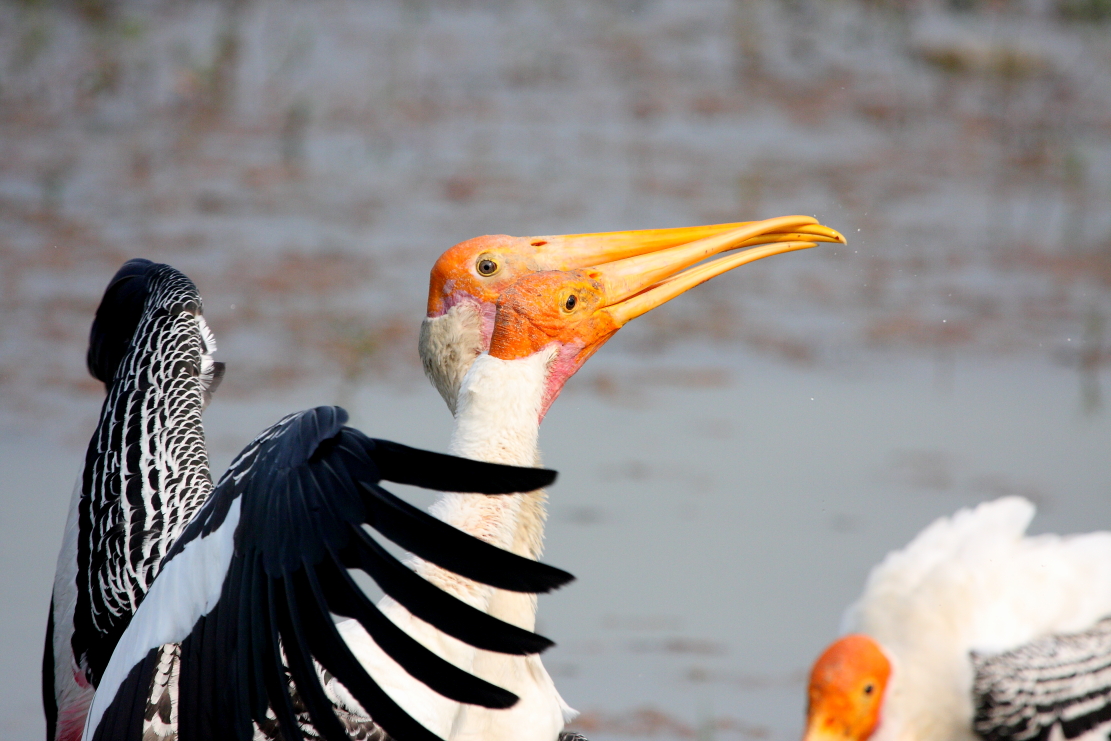

Then, the "vanquished" opponent either walks away, or, if feeling particularly adventurous, tries to disengage, and another bout of bill fencing ensues until the beak is in hand (or bill) again.


One bird, clearly tired of the forced bill-shutting (and perhaps finally alarmed at the dangerous jabs of the long bill so close to the face!), eventually flies away. And the winner, after some work, keeps the spoils!!


Better this I say than jabs to the body, bleeding wings, and gouged eyes. Maybe these happen too...

(All photos taken in 2015 from various locations in western Uttar Pradesh.)

Monday, May 3, 2010

The mad courtship of the Cotton Pygymy-goose

The Cotton Pygmy-goose is India's smallest Anatid (a group of birds comprising ducks and geese). The males are incredibly pretty, and the females are drab - characteristic of Anatids. One cloudy early morning, I chanced upon several small flocks spread out on a large lake. They appeared to be engaged in courtship. In this entry, I share my observation and attempts to photograph their mad yet delightful behaviour.

Each female - apparently unpaired as yet - was chased by 2-4 loudly honking males across the lake. Females appeared to be attempting to escape the loud and boisterous masculine efforts. But they kept up with her as she weaved around the lake. Above, the female is being pursued by four gorgeous males.

The female landed several times, perhaps tired, perhaps attempting to dissuade the males from further pursuit.

The female attempted also to take off again several times, and her troubles only grew as a result. All the males, honking their protest, gave chase.

They tried to ward her off, and females seldom managed to fly free again after the first landing.

The nearest male then physically dunked her back onto the water! Above, the female is on the extreme left hidden by the male who is pecking at her to force her to land on the water again.

The female then was in real danger of being drowned as the enthusiastic males rushed at her, frequently landing on top of her. The female was under water many times, as the males splashed around vying for her to choose them. The water churned madly as the males appeared to be nearly killing the female they were fighting to get.

Then suddenly and quite mysteriously, a partner had been chosen. He swam around her in slow circles with head bent forwards in a graceful bow, and the other males swam away honking their obvious disapproval.

Was this going to be her partner for the year? What was better about him compared to the other males who appeared as robust, noisy and interested? Another bird mystery that awaits study.

(All photographs taken on 02 May 2010 at Samaspur Bird Sanctuary, Rae Bareli.)

Sunday, April 25, 2010

Mud puddlers

Wet mud and butterflies - the two do go together.

Two-spot Grass Yellows bustle on wet mud

Male butterflies drink up moisture retaining only nutrients that are dissolved, and quickly get rid of the water that would otherwise weigh them down.

Common Mormons (background) and Common Gulls (foreground) puddle together

The nutrients are passed on to females during mating, and improve the chances of the eggs surviving.


Common Lime butterfly gets its share of nutrients

Nutrients are also obtained from over-ripe fruit, sap, dung, and rarely, even blood.

(All photographs were taken on 18 Apr 2010 at Katerniaghat Wildlife Sanctuary, Uttar Pradesh.)

Wednesday, February 10, 2010

Getting an earful

Bank Mynas and water buffaloes hit it off just great. The buffaloes have plenty of treats walking around on them for Mynas to actually be territorial on the buffaloes' back.

But the real battles are fought at the ears, for the ears, and going by how the buffaloes endure the vociferous battles taking place at their ear, it must be good for the ears.

(Photograph details: Mynas on buffaloes - shot at Basai wetland in Haryana on 6 Sep 2008; the vocal battle for the ear - shot at Etawah on 12 Feb 2009.)

Thursday, September 10, 2009

Body language

Cranes have among the largest non-vocal communication repertoires in the animal kingdom. Body language is exceedingly important. Here are a few Sarusy gestures that other cranes would know the meaning of instantly.

Wing half-open, an exaggerated walk with legs raised higher than usual, this crane walks up very meaningfully to another Sarus that had landed uncomfortably close to an active nest. The interloper got the message rather quickly!

Crane employ a large number of threat postures increasingly aggressive in their meaning. This female (right extreme) gives a classic ruffle-threat combined with a bow to the pair adjacent to her territory while her partner engages them at closer quarters.

This rare bow-threat is carried out with elan and grace successfully dissuading a pair flying overhead from landing in this crane's territory.

Cranes'
large body size and incredible physical prowess poses a great risk of physical injury should they need to joust physically each time a disagreement occurs. Non-vocal postures with specific meaning, like the three above, are a safer alternative for all concerned.

(Photographs information: Top: 10 Ju
l 2008, Mainpuri district; middle: 28 Nov 2008, Etawah district; bottom: 07 Sep 2009, Farrukhabad district.)

Monday, September 7, 2009

Wing-stretch

All birds stretch their wings to get the blood flowing and stretch tired muscles. When the world's tallest flying bird does it, the simple activity becomes a spectacular sight! The world is truly its oyster.

(Photo detai
ls: All photos taken on 07 Sep 2009 in Farrukhabad district.)

Monday, August 31, 2009

Morning with the Sarus

Walking around in the flooded rice paddies during the monsoon can be magical. The Sarus make it more so. Here are two photographs that underline this statement.


The rains ensure that there is plenty of wet, grassy wetlands to forage in. This Sarus was part of a flock of 45 that landed in this wetland and surrounded us for a fantastic few minutes.

Real estate is serious business in the bird world. On a cloudy and otherwise dull morning, a pair of Sarus landed a few feet ahead of us and proceeded to unison call (photo above), gesture threateningly and finally succeeded in chasing away another pair that had landed in their territory.

(Photographs were taken in Etah district on 28 Aug and 29 Aug 2009 respective
ly.)

Monday, July 13, 2009

Chambal Diary: 6. River Lapwing

Previously aptly named the "Spur-winged Plover", the River Lapwing is a striking species with real spurs on its wings (see above) used during duels with fellow River Lapwings. These distinct more-or-less black-and-white birds share the riverside at Chambal with two other resident lapwing species - the Red- and Yellow-wattled Lapwings.


River Lapwings, as their name suggests, are found primarily along rivers. They find their food - insects, and other creepy-crawlies - in the sand and on vegetation along the rivers.


This species is adapted very well to river systems. They lay and incubate their eggs in a shallow scoop in the sand on river-banks and islands, much like their neighbours the terns and skimmers. Above, a lapwing incubates eggs beside a sleeping Comb Duck.


They are watchful parents. Here, one adult watches cautiously after ensuring that its chicks are well hidden among the scattered rocks on the island.


3-4 eggs are laid in the simple scoop - above a lapwing adjusts the eggs in the nest. Eggs are cryptically coloured: if the incubating bird were to walk away, it is exceedingly difficult to spot them on the sand.

(A
ll photos taken in the National Chambal Sanctuary, Uttar Pradesh on 9 Apr 2009.)


Sunday, July 5, 2009

Chambal diary: 5. Little Tern

The Little Tern is the smallest of the resident terns in the Chambal - tiny compared to the much larger skimmers and river terns. Instead of a neat full black cap, they have a white forehead, and a streak of black serving as eye-patches. Their legs are also much less colourful compared to their fellow terns and skimmers.

In this entry, I describe the nesting behaviour of this species of terns. Most of this behaviour is common with the other terns and the skimmer. This blog entry gives a snapshot into the part-ritual and part-politics that is an inherent part of the terns' lives.

The first thing to do for the males is to find a female who does not chase them away. A gift of a fish is mandatory to beginning the courtship ritual. Birds paired initially like this spend a long time - sometimes hours - standing in the position showed above calling to each other. The male ensures that the female does not snatch the fish away, but keeps it as tantalising bait until the female is ready to mate.

Competition for mates is common! Here, a male with a much larger fish tries to break up the courtship, but the male and the female bird that have bonded scare away the interloper. Clearly, size of the bait-fish is not everything!

After much posturing and courtship, the female finally allows the male to mate with her, and the male relinquishes the fish.

Mating itself lasts a very short time.

It appears to be the males' job to choose the spot where the female will lay their eggs. It is also his job to create the depression in the sand that will serve as the nest. The bird uses its belly, wriggles around in a circle until a depression is formed. The female watches over the whole exercise carefully.

Nests are located some distance from each other, and pairs are fiercely protective. There is a lot of jousting for space - both on the sand and in the air. Observing birds that nest in riverine islands is very rewarding. There is seldom a boring moment. Obsevers need to be very careful not to disturb the birds. It is less important to get full-frame photographs, for example, than it is to ensure that the birds are not disturbed.

Islands in the Chambal are exceedingly important for populations of a range of species, and here is to wishing that it continues to be do!


(All photos were taken on Apr 10, 2009 at the National Chambal Sanctuary, Etawah.)

Friday, June 19, 2009

Its clean-up time!

Preen, dip, bathe, and scratch! These are the various ways in which birdies take good care of their precious feathers. Here are a few examples taken during clean-up time!

Preening is so very time-consuming! Here an Indian Skimmer (top) uses its unusual, spectacular beak to comb through feathers, and a Silverbill is busy at it while also showing off the preen gland (just above the tail) from where birds get an "oil" to keep their feathers ship-shape!


A bath can be a serene experience, like the Shikra in the water. Else it can be boisterous with water flying everwhere: for some Comb Ducks, one duck's bathwater is another's drink, apparently!

And finally, the soothing scratch! Here a Silverbill, a Black-necked Stork juvenile, and a Sarus Crane find out the real meaning of the phrase "for every itch, there is a scratch"!

(Photograph information: Skimmer - Etawah district, Apr 9, 2009; Si
lverbill preening - lucknow, Nov 27, 2008; Shikra - Barabanki, Nov 23, 2008; Comb Duck - Etawah, Apr 9, 2009; Silverbill scratch - Barabanki, Nov 25, 2008; Black-necked Stork - Mainpuri, Apr 7, 2009; Sarus Crane - Etawah, Feb 12, 2009. Thanks to Satish for the scratch-itch phrase!)

Tuesday, June 2, 2009

Everybody loves a good sun


The Gangetic flood plains can get pretty cold in the winter, and in the early mornings of any season. Sunning is therefore a commonly noticed activity in the myriad life forms here - nothing quite like some temperature to put life back into the frozen bones. Here are a few life-forms doing their thing in the sun.

From top: A Baron butterfly warms up atop a garden plant; the Kachuga turtle suns atop a Gharial that is a fish-eater (something that the turtle obviously knows); a Green Bee-eater and a Greater Coucal open up their feathers to let the sun warm up the darker feathers on their backs.

(Photograph information: Baron - Dec 7, 2008, Rae Bareli district; Turtle-and-Gharial - Jan 18, 2009, National Chambal Sanctuary, Etawah district; Green Bee-eater - Apr 7, 2009, Etawah district; Coucal - Dec 25, 2008, Jaunpur district)